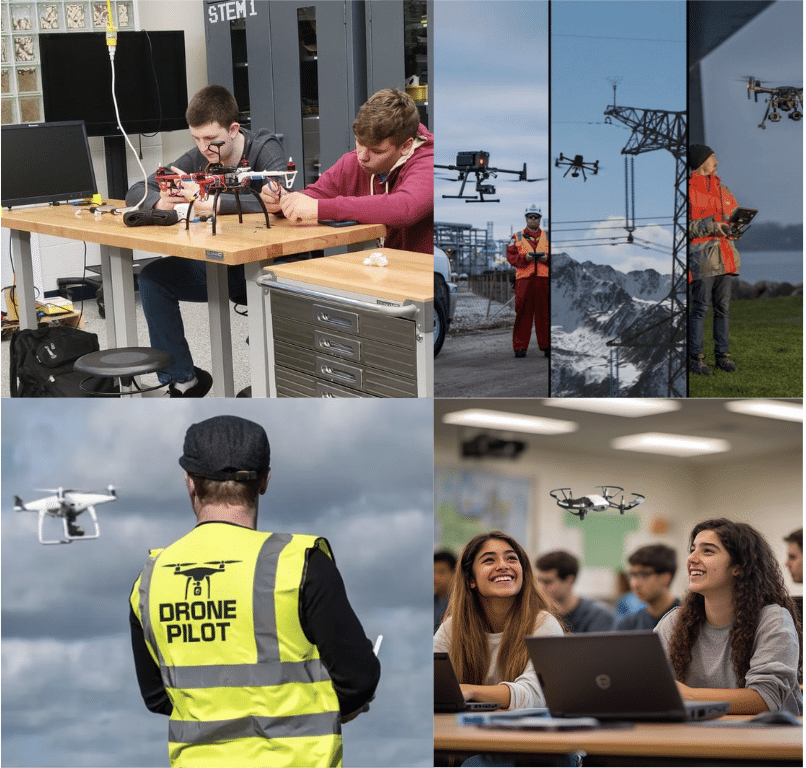
For many students, physics concepts can feel abstract when they are only introduced through equations, textbooks, or diagrams. Concepts like force, inertia, acceleration, and momentum often become much easier to understand when students can see them happening in real time.
That is one reason programmable drones are becoming increasingly valuable in STEM and science classrooms. Every flight demonstrates physics in motion. Students are observing them, testing them, and applying them through hands-on experimentation.
Why Drones Work Well for Physics Education
Drones in education provide an immediate visual connection between scientific theory and physical movement. Students can see how drag affects speed, how thrust changes altitude, and how force influences motion.
Instead of asking students to imagine how Newton’s Laws work, drones allow them to experience those concepts directly through flight tests, data collection, obstacle challenges, and controlled experiments.
This type of hands-on learning can improve engagement while helping students better connect physics principles to real-world systems used in aviation, logistics, robotics, agriculture, and engineering.
Newton’s First Law: Inertia in Flight
Newton’s First Law states that an object at rest stays at rest, and an object in motion stays in motion unless acted upon by an external force.
Drones provide a clear demonstration of this principle. When hovering, the drone maintains position through balanced forces. Once moving forward, the drone continues in motion until opposing forces such as drag, pilot input, or directional adjustments slow it down or stop it.
Students can observe inertia during:
- Hover stabilization exercises
- Emergency stop maneuvers
- Sudden directional changes
- Wind resistance demonstrations
These activities help students understand that motion changes only when forces become unbalanced.
Newton’s Second Law: Force, Mass, and Acceleration
Newton’s Second Law explains how force affects acceleration based on mass.
F = ma
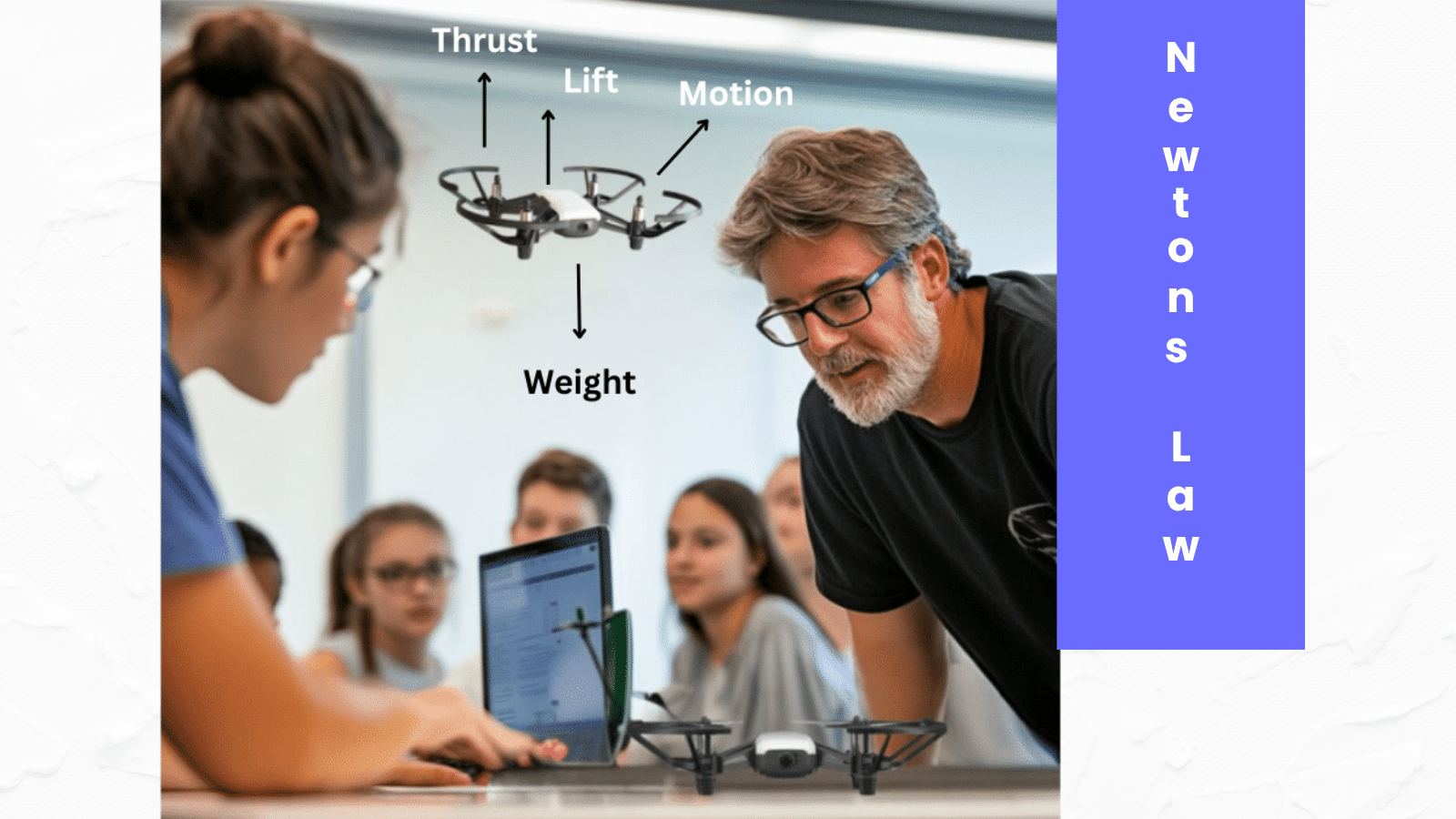
This concept becomes highly visible during drone flight. Increasing propeller speed increases thrust, which changes acceleration and altitude. Additional payload weight changes how much force is needed to lift and maneuver the drone.
Students can experiment with:
- Different flight speeds
- Acceleration tests
- Payload challenges
- Battery performance comparisons
- Takeoff force measurements
These experiments help students connect mathematical equations to physical outcomes they can measure and observe.
Newton’s Third Law: Action and Reaction
Newton’s Third Law states that every action has an equal and opposite reaction.
F_{12} = -F_{21}
Drone flight depends entirely on this principle. The propellers push air downward, and the air pushes the drone upward with an equal opposing force that creates lift.
This gives students a practical way to understand how aircraft generate flight. Instead of viewing lift as an abstract concept, students can directly observe how propeller speed, airflow, and stability interact during takeoff and maneuvering.
Classroom activities may include:
- Lift and thrust experiments
- Stability testing
- Propeller design comparisons
- Hover efficiency analysis
- Flight path optimization
Connecting Physics to Modern Technology
One of the strengths of drone-based STEM education is that it combines physics with technology students already recognize from the real world.
Modern industries increasingly rely on autonomous systems, robotics, aerial imaging, and sensor-driven technologies. Drones create opportunities for students to explore how physics supports these systems while also developing engineering, problem-solving, and analytical skills.
Students begin seeing how classroom science connects to:
- Aviation systems
- Robotics and automation
- Infrastructure inspection
- Environmental monitoring
- Agricultural technology
- Autonomous navigation systems
This helps move physics beyond memorization and toward practical application.
Making Physics More Interactive
Many students learn best when they can test ideas, make adjustments, and observe immediate outcomes. Drones create opportunities for experimentation where students can:
- Predict flight behavior
- Test hypotheses
- Analyze performance data
- Troubleshoot flight issues
- Improve flight stability through iteration
These activities encourage critical thinking while reinforcing core science and engineering concepts.
Bringing Flight Physics Into the Classroom With LocoRobo
At LocoRobo, we help schools bring hands-on educational drone kits into STEM, science, computer science, and CTE programs through classroom-ready drone education solutions designed for different grade levels.
Our drone programming ecosystem includes:
- Standards-aligned drone curriculum
- Block-based and Python drone coding options
- Indoor and outdoor drone platforms
- Teacher training and implementation support
- Science and physics-focused drone lessons
- Career-connected learning pathways
From introductory flight concepts to advanced autonomous systems, LocoRobo helps educators create engaging learning experiences that connect physics, engineering, and modern technology through real-world applications.
Explore LocoRobo’s drone solutions to see how drones can support physics and STEM learning in your classroom.