

Why Hands-On Programming Helps Students Learn Faster and Smarter
Computer science is a cornerstone of STEM education, giving students essential skills in critical thinking, logic, and problem-solving. But while learning to code is valuable, many students struggle when programming is taught in a purely abstract way. Traditional lessons often lack visual feedback or real-world context, making it difficult for students to grasp how their code works or what went wrong.
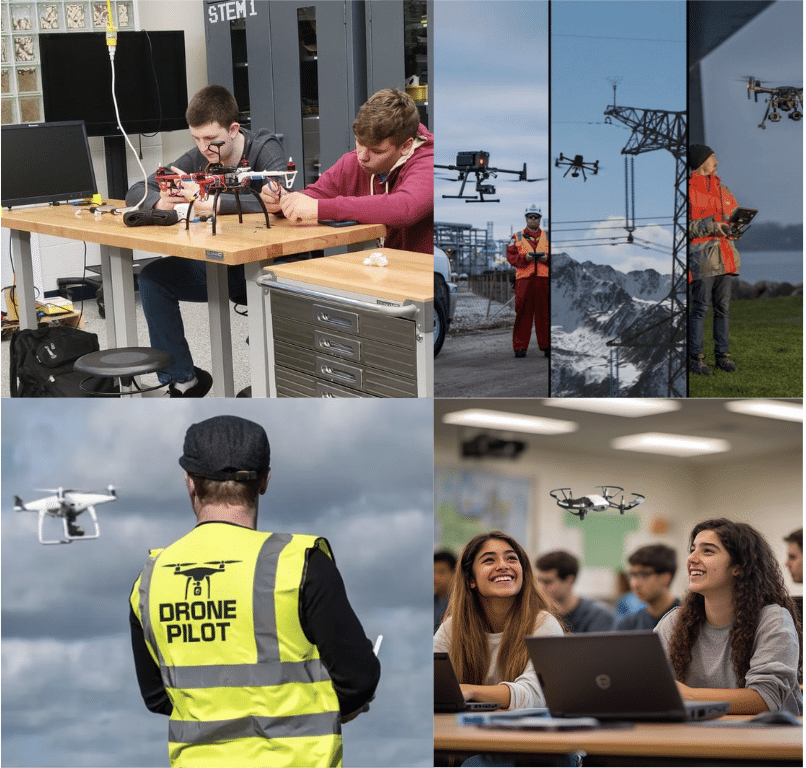
Introducing drones into computer science is a game-changer.
Drones Make Abstract Concepts Concrete
One of the hardest parts of learning to code is understanding what the code is doing behind the scenes. When students write code on a screen, errors can be difficult to visualize. Did the conditional statement behave as expected? Did the loop run too many times? Why did nothing happen? These questions can be hard to answer without a clear outcome to observe.
With drones, students get immediate, visual feedback. If the drone spins in the wrong direction or stops short of its target, students can see the result of a coding mistake instantly. This real-time connection between logic and action helps students debug more effectively and understand abstract programming concepts like:
- Control flow (loops, conditionals)
- Timers, delays, and event triggers
- Coordinate systems and spatial reasoning
By watching their drone respond to each block of code, students develop a clearer mental model of how programming logic translates into behavior.
From Trial-and-Error to Iteration and Insight
Traditional CS lessons often isolate coding tasks from real-world experimentation. Students may be tasked with writing a loop to print numbers or sort data, but these tasks can feel repetitive and disconnected.
In drone coding, the process becomes more dynamic. Students plan a flight path, test it, analyze the outcome, and then refine their code. This iterative process teaches them how to think like a programmer: identify a problem, test a solution, analyze the output, and improve it.
Mistakes are learning opportunities. Seeing a drone overshoot a landing zone is far more memorable than a line of text saying “IndexError: list index out of range.”
Supporting Different Learning Styles
Not every student learns best through text-based code on a screen. Drones support multimodal learning by combining visual, kinesthetic, and collaborative elements. Students who struggle with abstract logic may find it easier to understand when they can physically observe the outcomes.
For example:
- A student confused by nested loops can watch how a drone follows complex waypoints.
- Those struggling with conditionals can see how a drone responds differently when sensors detect obstacles.
This type of hands-on learning builds confidence and comprehension across a broader range of learners.
Coding Alone vs. Coding Together
Many traditional CS exercises are done individually. While independent work has its place, it can limit the kinds of skills students develop, especially collaboration and communication
Drone coding projects naturally lend themselves to teamwork. Students must coordinate roles, share responsibilities, and work together to solve problems like:
- Debugging erratic flight behavior
- Calibrating sensors for stable navigation
- Mapping a drone’s route for a mission
This mirrors the collaborative nature of real-world engineering and software development and prepares students for future team-based STEM careers.
Code Structure vs. Systems Thinking
Typical coding exercises often focus on writing isolated functions or simple programs. But drones help students think beyond code syntax by interacting with physical systems. They begin to ask:
- How does code interact with hardware?
- How do real-time constraints (like battery life or flight stability) affect our design?
- What sensor data do we need, and how do we process it?
This systems-level thinking helps students connect programming to broader engineering and technical challenges.
Learning Outcomes: What Students Actually Gain
Without drones, computer science classes may cover:
- Basic programming syntax
- Fundamental concepts like loops and variables
- Logical problem-solving
With drones for education, students also gain:
- Visual understanding of cause and effect in code
- Sharper debugging skills through real-time feedback
- Collaboration and communication experience
- Deeper retention through hands-on iteration
- Systems thinking across hardware and software
Bring Real-World Coding Into Your Classroom
At LocoRobo, we help schools bring drone-powered computer science to life. Our drone curriculum is designed for real classrooms, no experience required.
Explore our drone coding solutions that engage learners, support teachers, and build career-ready skills. Request the infographic to learn more.