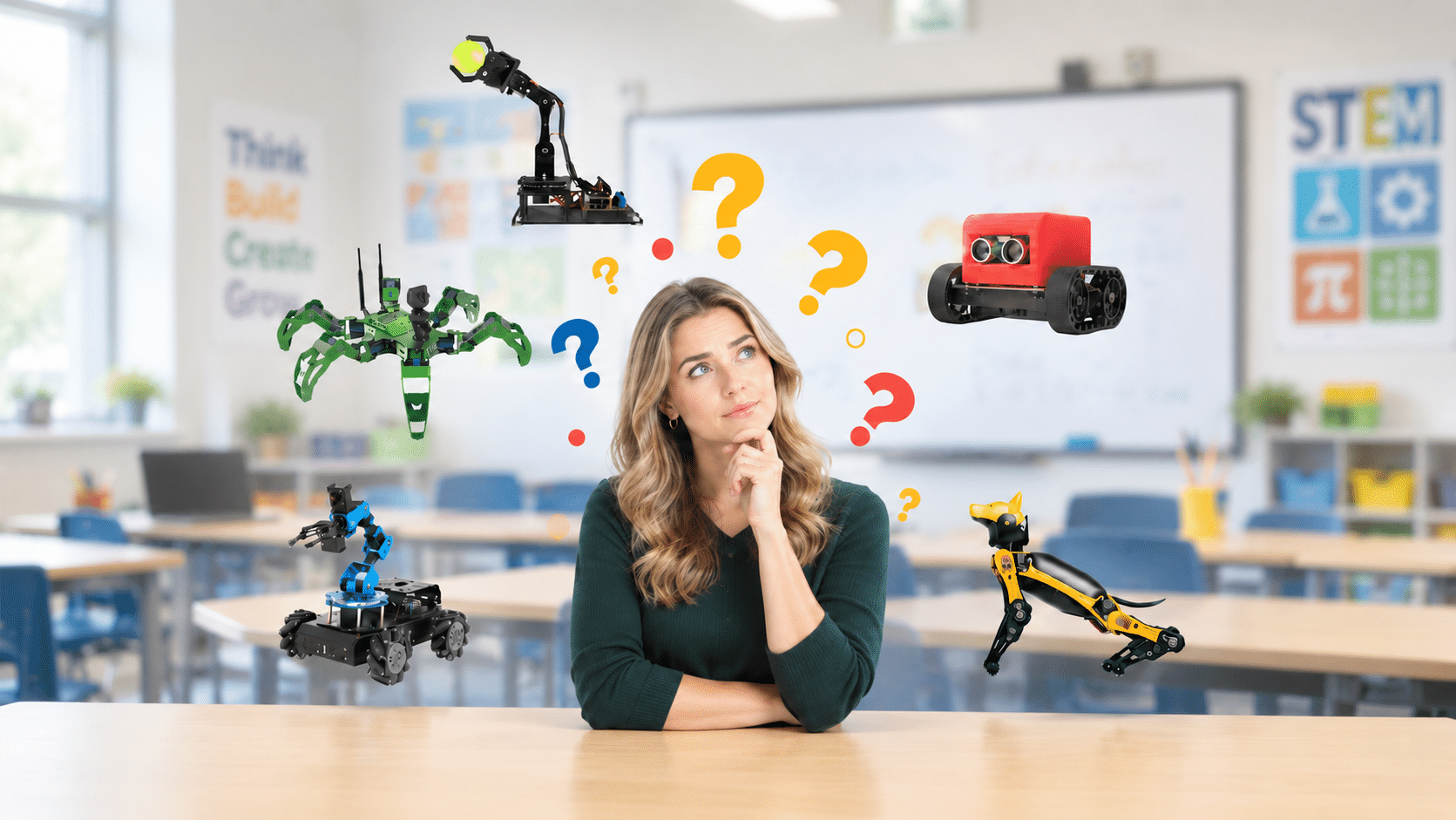

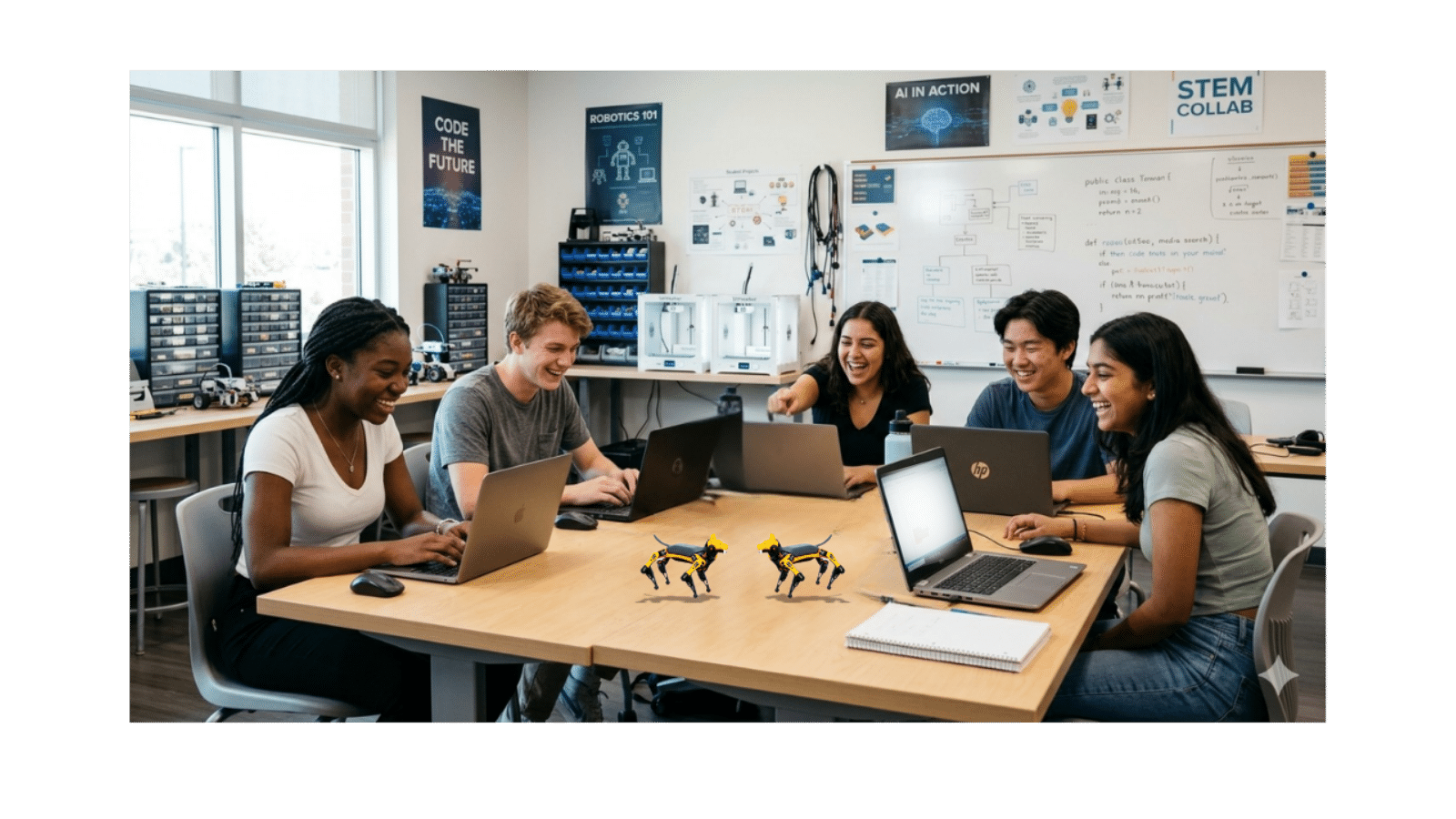
Quadruped robots for STEM education give students a powerful way to explore advanced locomotion, balance, and robotics control systems. Unlike wheeled robots, quadruped robots walk, adapt, and stabilize themselves, making them ideal tools for teaching how complex robotic systems move in real-world environments. While it may seem simple on the surface, getting a robot to move smoothly, stay balanced, and adapt to its surroundings requires precise coordination between hardware, software, and control systems.
This is where quadruped robots stand out.
Four-legged robots introduce a completely different way of thinking about motion. Instead of rolling across flat surfaces, they walk, adapt, and balance. That shift makes them one of the most effective tools for teaching control systems, advanced locomotion, and real-world robotics applications.
Why Quadruped Robots for STEM Education Teach Advanced Locomotion
Wheeled robots operate on relatively simple principles. Movement is continuous, and stability is largely built into the design. Quadruped robots, on the other hand, require active coordination.
Students must think about:
- How each leg moves in relation to the others
- How weight shifts across the robot’s body
- How balance is maintained during motion
- How to adjust movement based on terrain
This introduces a deeper level of problem-solving. Motion becomes a question of timing, sequencing, and adaptation.
Gait Control in Quadruped Robots for STEM Education
One of the most valuable concepts students learn with quadruped robots is gait control.
A gait defines how a robot moves its legs to walk. Common examples include:
- Trot gait: Diagonal leg pairs move together for balanced forward motion
- Crawl gait: One leg moves at a time for maximum stability
Each gait presents trade-offs between stability, speed, and efficiency.
By experimenting with these patterns, students begin to understand how engineers design robots for different environments. A fast gait might work on flat ground, while a slower, more stable gait is needed for uneven terrain.
Real-Time Balance and Stability
Quadruped robots constantly adjust to stay upright. This introduces students to:
- Center of gravity and weight distribution
- Feedback systems from sensors
- Continuous adjustments during motion
Even a small robot programming change can affect stability. Students quickly see how precise control is required to maintain balance, especially when the robot is walking, turning, or climbing.
This kind of real-time feedback builds intuition that is difficult to achieve through simulations alone.
Navigating Real-World Environments
One of the biggest advantages of robotic dogs is their ability to handle environments that wheels struggle with.
They can:
- Walk over uneven terrain
- Climb small inclines or stairs
- Step around obstacles
- Adjust movement based on surface conditions
This opens the door to projects that feel closer to real-world robotics applications, such as:
- Search and rescue simulations
- Inspection tasks in hard-to-reach areas
- Terrain mapping challenges
Sensors, AI, and Autonomous Movement
Advanced programmable robot dog often include sensors like depth cameras and LiDAR. These allow the robot to perceive its environment and make decisions.
Students can explore:
- Mapping and navigation
- Obstacle detection and avoidance
- Path planning
- Autonomous behavior
This connects locomotion with AI and data processing. Movement is no longer pre-programmed. It becomes responsive and adaptive.
Why Quadruped Robots Work So Well in STEM Education
Quadruped robots naturally combine multiple disciplines:
- Physics: Forces, balance, and motion
- Engineering: Mechanical design and control systems
- AI and Data: Perception and decision-making
- Computer Science: Programming logic and algorithms
Because of this, they support project-based learning where students build, test, and refine their ideas.
They also introduce productive struggle. Getting a robot to walk smoothly, students iterate, debug, and improve, which mirrors how real engineering work happens.
Bringing Quadruped Robotics Into the Classroom
As schools expand their STEM and CTE pathways, there is growing interest in advancing robotics in classroom environments beyond introductory concepts.
LocoScout offers a clear next step.
It challenges students to think differently about motion, systems, and autonomy while giving them a hands-on way to explore advanced robotics concepts.
What Students Can Explore with LocoScout
With LocoScout quadruped robotics students engage with robotics in a way that connects movement, coding, and real-world problem-solving.
Students can:
- Program lifelike robotic movement and explore gait control
- Progress from block coding to Python through structured challenges
- Work with sensors for navigation and environmental awareness
- Develop adaptive behaviors based on real-time inputs
- Build projects that connect robotics to real-world applications like search-and-rescue and inspection scenarios
Beyond the hardware, LocoRobo provides:
- A complete, ready-to-go solution with hardware, software, and curriculum in one system
- Classroom-ready curriculum aligned to STEM and CTE pathways
- Teacher training and professional development
- Ongoing support to help educators run and expand their robotics programs
Quadruped robotics is about helping students understand how complex systems move, adapt, and operate in the real world.
With the right tools and support, that level of learning becomes practical and achievable in the classroom.
Frequently Asked Questions
What are quadruped robots and how are they used in STEM education?
Quadruped robots are four-legged robots designed to walk, balance, and adapt to different environments. In STEM education, they are used to teach advanced concepts like locomotion, control systems, and real-time feedback. Unlike wheeled robots, quadruped robots require students to think about movement, balance, and coordination, making them effective tools for hands-on learning in robotics programs.
What skills do students learn from quadruped robotics projects?
Students develop skills across multiple STEM areas, including:
- Programming logic and sequencing
- Engineering concepts like motion and stability
- Problem-solving through testing and iteration
- Understanding sensors, AI, and autonomous behavior
These projects connect coding with physical outcomes, helping students see how robotics works in real-world applications.
Do teachers need robotics or coding experience to teach quadruped robotics?
No. Many classroom robotics platforms, such as LocoScout, include structured curriculum, guided lessons, and teacher support. Educators can start with block-based coding and gradually introduce more advanced concepts like Python. With the right tools, teachers can focus on facilitating learning while students explore robotics through hands-on projects.
How do quadruped robots connect to real-world careers and applications?
Quadruped robots are used in industries such as search and rescue, inspection, and environmental monitoring. In the classroom, students can simulate these applications through projects like terrain navigation, obstacle avoidance, and autonomous movement. This helps connect STEM learning to career pathways in robotics, AI, and engineering.