

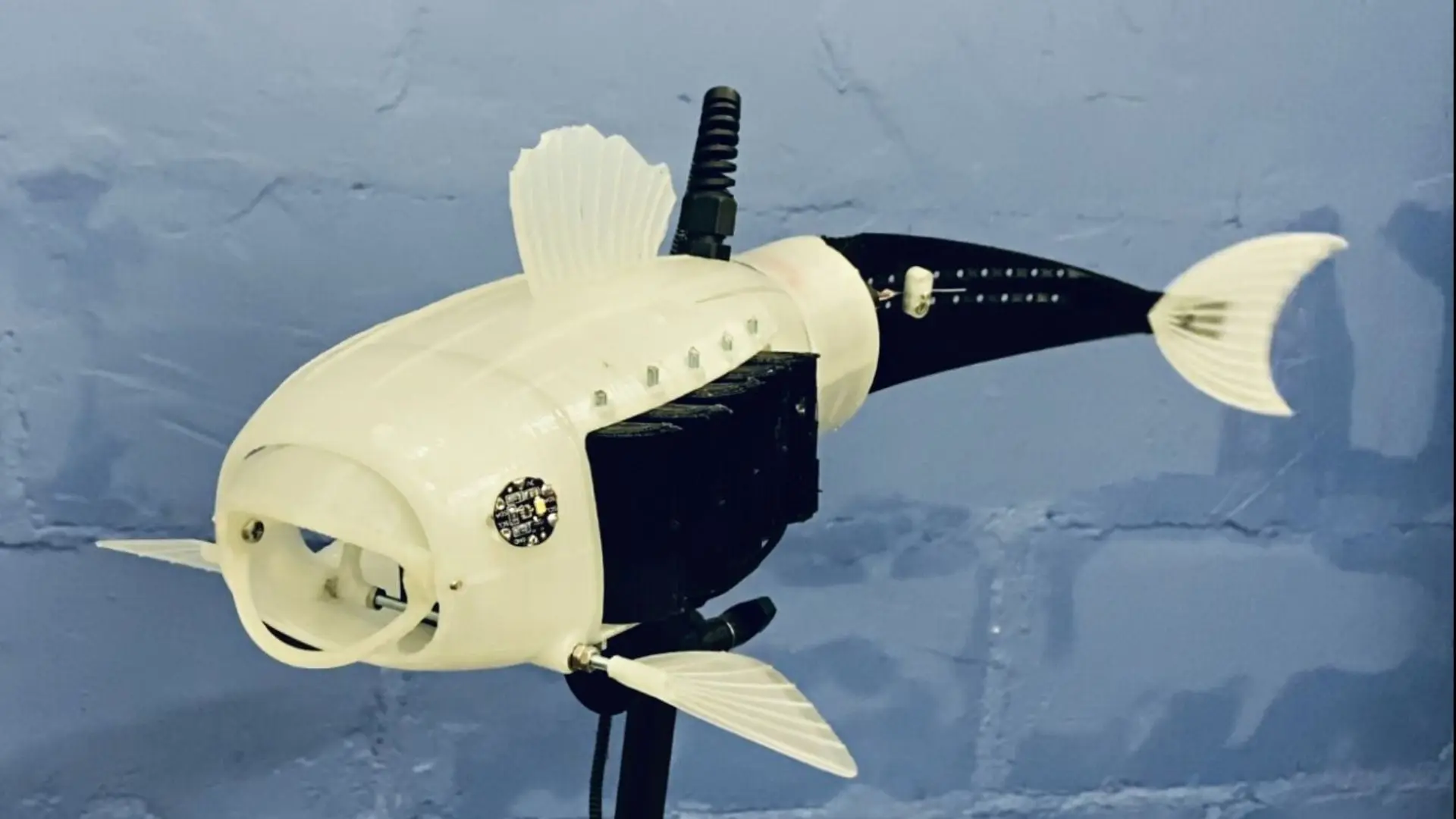
A team at the University of Surrey has introduced a robotic fish designed to address one of the most persistent environmental challenges: microplastic pollution.
Nicknamed “Gillbert,” the bio-inspired, foot-long robot uses a microbial fuel cell to digest captured plastic particles and convert them into energy. In simple terms, the more plastic it consumes, the more power it generates to keep swimming.
This approach reframes what environmental robotics can do. The system links environmental cleanup directly to energy production instead of relying solely on external charging.
How the Robot Works
The robotic fish swims with a tail-flapping motion similar to a salmon. As it moves:
- Its mouth remains open to pull in water
- A fine internal mesh captures microplastics as small as two millimeters
- Clean water exits through gill-like flaps
- Sensors monitor light levels and water quality
- A glow-in-the-dark feature helps researchers track its movement
The key innovation is the onboard microbial fuel cell. Microorganisms break down plastic particles, producing electrons that power the robot. This closes a small but meaningful loop between energy generation and waste removal.
Future versions are expected to capture smaller particles, operate autonomously, and travel farther distances.
Why This Matters for Robotics Education
Microplastics are now found in soil, waterways, food systems, and even the human bloodstream. Solutions require more than cleanup. They demand:
- Sensor integration
- Autonomous navigation
- Environmental data collection
- Energy-efficient systems
- Bio-inspired mechanical design
This robotic fish brings all of those disciplines together in a single platform.
For students, stories like this show that robotics is not limited to logistics or manufacturing. It is increasingly connected to environmental science, sustainability engineering, and real-world problem solving.
When robotics intersects with ecology, students see how hardware design, coding, and sensor data can directly impact public health and environmental systems.
The Power of Open Design
One of the most compelling aspects of the project is its open-source nature. The design is available for download and can be 3D printed, allowing educators, researchers, and innovators worldwide to build and iterate on the concept.
This model encourages distributed innovation. Instead of one lab solving the problem, many can contribute to improvements.
For classrooms, this reflects a broader shift in STEM education:
Students are learning how systems work and how to improve them.
From Industry Innovation to Classroom Exploration
Industry stories like this offer a powerful entry point for STEM learning. Teachers can connect this innovation to lessons on:
- Bio-inspired robotics
- Renewable and alternative energy systems
- Sensor calibration and environmental data
- Autonomous robotics and navigation logic
- Sustainable engineering design
Students begin to see robotics as a tool for environmental stewardship, not just automation.
That shift matters.
Where Classroom Learning Meets Real-World Problem Solving
At LocoRobo, we believe robotics STEM education should connect directly to real-world challenges. Environmental monitoring, autonomous systems, and sensor-based decision making are not distant concepts. They are skills students can begin developing today.
Our STEM robotics kits are designed to help students:
- Program autonomous movement and decision-making logic
- Integrate sensors to collect and interpret real-time data
- Connect hardware components with software control systems
- Design and test robotic systems that address practical problems
- Apply engineering concepts to structured, real-world challenges
Innovations like the plastic-eating robotic fish show what is possible when engineering creativity meets environmental urgency. Robotics in the classroom can be the starting point for that kind of thinking.
If you are looking to build a K12 robotics pathway that connects coding, hardware, and real-world impact, explore LocoRobo’s robotics solutions and see how your students can begin designing systems that address the challenges shaping their world.