
Block coding is often where students first learn how to program.
Instead of worrying about punctuation, spelling, or syntax, students can focus on the logic behind a program. They learn how sequences work, how loops repeat actions, how conditions influence behavior, and how inputs can change an output.
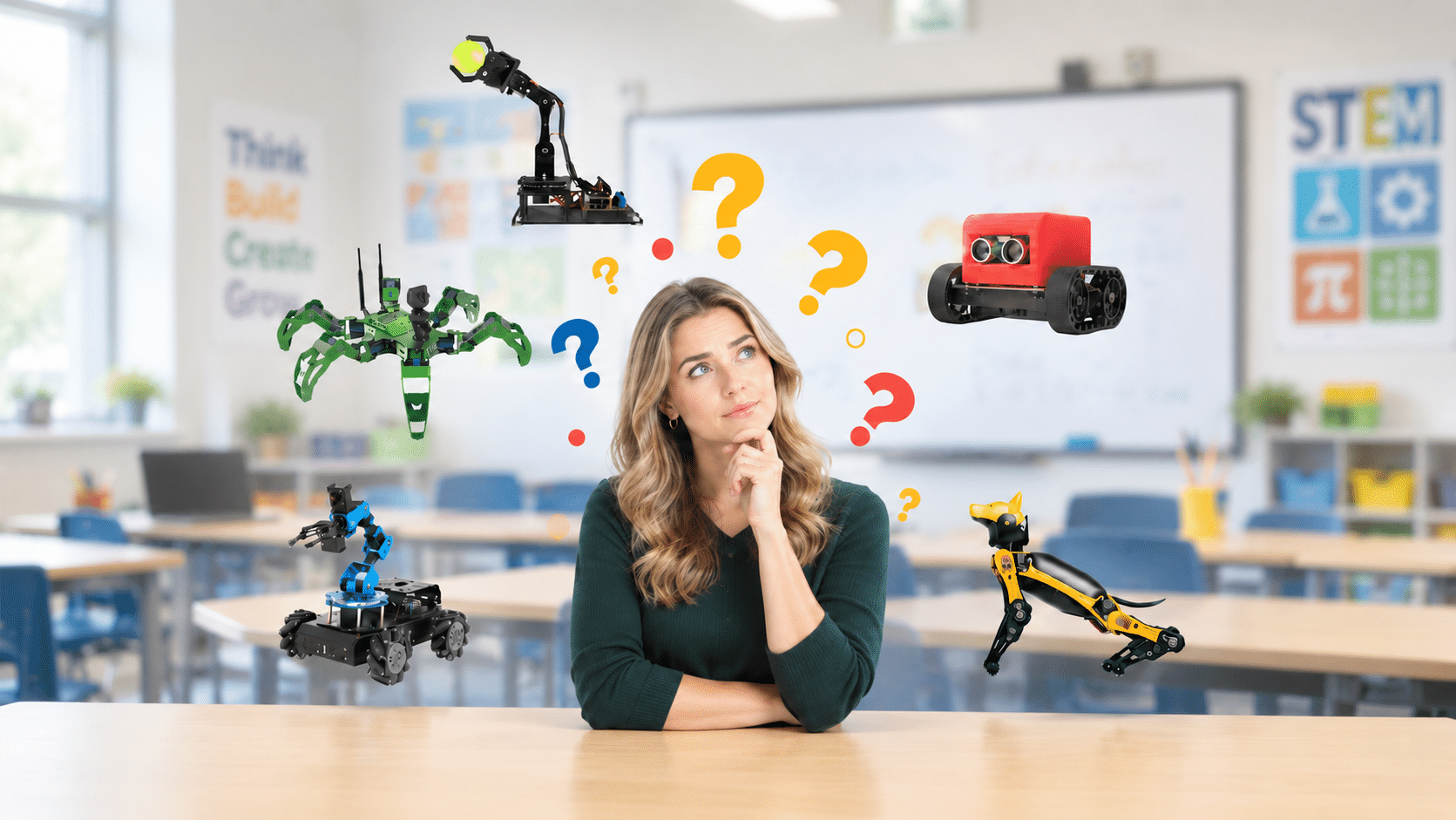
Eventually, though, many teachers face the same question:
When should students move from block coding to Python?
There is no single grade level or number of lessons that determines when a student is ready.
The better question is whether block coding is still helping the student think about programming, or whether it is beginning to limit what the student can build.
Why Start With Block Coding?
Block coding removes some of the barriers that can make programming intimidating for beginners.
Students can drag commands into place rather than remembering exactly how to type them. Blocks often fit together only when the commands are compatible, which reduces syntax errors and allows students to see the structure of a program more clearly.
That makes block coding particularly useful for introducing concepts such as:
- Sequences
- Variables
- Loops
- Conditionals
- Functions
- Events
- Sensors and inputs
- Basic debugging
For younger students and students encountering programming for the first time, this can be an effective way to build confidence with computational thinking.
But block coding should not become the destination simply because students are comfortable using it.
There Is No Magic Grade for Moving to Python
Student readiness does not always follow grade levels.
A middle school student with several years of programming experience may be ready for Python earlier. A high school student encountering programming for the first time may benefit from beginning with blocks before moving into text.
The transition should depend more on what students understand than how old they are.
5 Signs Students May Be Ready for Python
1. Students Understand the Logic Behind Their Programs
Students should be able to explain why their program works.
If they use a conditional, do they understand what determines which action happens?
If they use a loop, can they explain what is repeating and why?
If they change a variable, can they predict how that change will affect the program?
A student who understands the logic behind the blocks has already learned something much more important than where to drag them.
That knowledge can carry into Python.
2. Students Can Build Without Constant Step-by-Step Instructions
Early coding activities often tell students exactly what to do:
Add this block.
Change this value.
Connect these commands.
Run the program.
That structure is useful at the beginning. Eventually, students should begin making more of those decisions themselves.
Give them a goal rather than a complete sequence of instructions.
Can they decide which commands they need? Can they break the challenge into smaller parts? Can they test an idea and revise it when something goes wrong?
Growing independence is a strong sign that students may be ready for the additional complexity of text-based programming.
3. Students Are Debugging Instead of Immediately Asking for the Answer
Programming rarely works perfectly on the first attempt.
Students who are ready to progress should be developing strategies for figuring out what went wrong.
They might:
- Run smaller parts of the program
- Check values
- Change one command at a time
- Compare expected and actual behavior
- Trace the sequence of instructions
- Ask why something happened
This matters because Python introduces a new category of problems.
A missing colon, misspelled variable, incorrect indentation, or misplaced character can prevent code from running.
Students do not need to be expert debuggers before starting Python. They do need to understand that errors are something to investigate.
4. Students Are Starting to Feel Limited by Blocks
Sometimes the clearest signal comes from the students themselves.
They want to build something more complex.
They want greater control over a robot.
They want to process data differently.
They want to create a program that does not fit neatly into the available blocks.
At this point, text-based programming can become useful because it gives students more flexibility in how they structure and extend their programs.
Python is no longer simply “the harder version.”
It becomes a tool that helps students do more.
5. Students Can Read Simple Code and Connect It to What They Already Know
Before asking students to write an entire Python program from scratch, show them short examples.
For instance, students who understand a repeat block can begin looking at a Python for loop.
Students familiar with an if/else block can examine the same logic written as an if/else statement.
Ask students:
What is different?
What do you recognize?
What do you think this line does?
If students can connect text-based code to programming concepts they already understand, the move to Python becomes much less abrupt.
Do Not Treat the Transition as Blocks Today, Python Tomorrow
One of the most useful approaches is to create an overlap between the two.
Students do not necessarily need to finish block coding permanently before they see Python.
Instead, teachers can place the two representations next to each other.
A block program might tell a robot to:
- Move forward.
- Check a sensor.
- Turn if an obstacle is detected.
- Repeat.
Students can first build the behavior with blocks.
Then they can examine how the same logic appears in Python.
The programming concept has not changed. The way students communicate that concept to the computer has.
That distinction is important.
Block Coding Is a Foundation for Python
There can be a tendency to treat block coding as something students need to “graduate from.”
That misses its purpose.
Blocks give students a visual model of programming logic. Python asks them to express many of those same ideas through text.
A strong progression uses each tool when it is most useful.
Start with blocks when syntax would distract students from understanding the concept.
Introduce Python when students understand the underlying logic and are ready for greater flexibility, independence, and complexity.
The goal is not to move students to Python as quickly as possible.
The goal is to make sure that when they get there, they understand what they are writing and why.
Build a Coding Pathway That Grows With Your Students
LocoRobo helps schools build STEM and CS pathways that can grow from introductory coding into Python, robotics, drones, AI, autonomous systems, and more advanced applications.
Students can begin by learning programming concepts through accessible, hands-on STEM learning and progress toward text-based programming as their skills develop. With robotics and drone platforms, Python becomes more than an exercise on a screen. Students can use their code to control movement, respond to sensors, automate behaviors, and solve increasingly complex challenges.
For schools, that means the progression does not have to be a collection of disconnected coding activities. STEM Curriculum, technology, professional development, and implementation support can be planned around where students are starting and where the program wants them to go next.
Planning a coding, robotics, or drone pathway for your students?
Let’s Talk About Your STEM and CTE Program.