
Training a robot to work in the real world takes a lot of data.
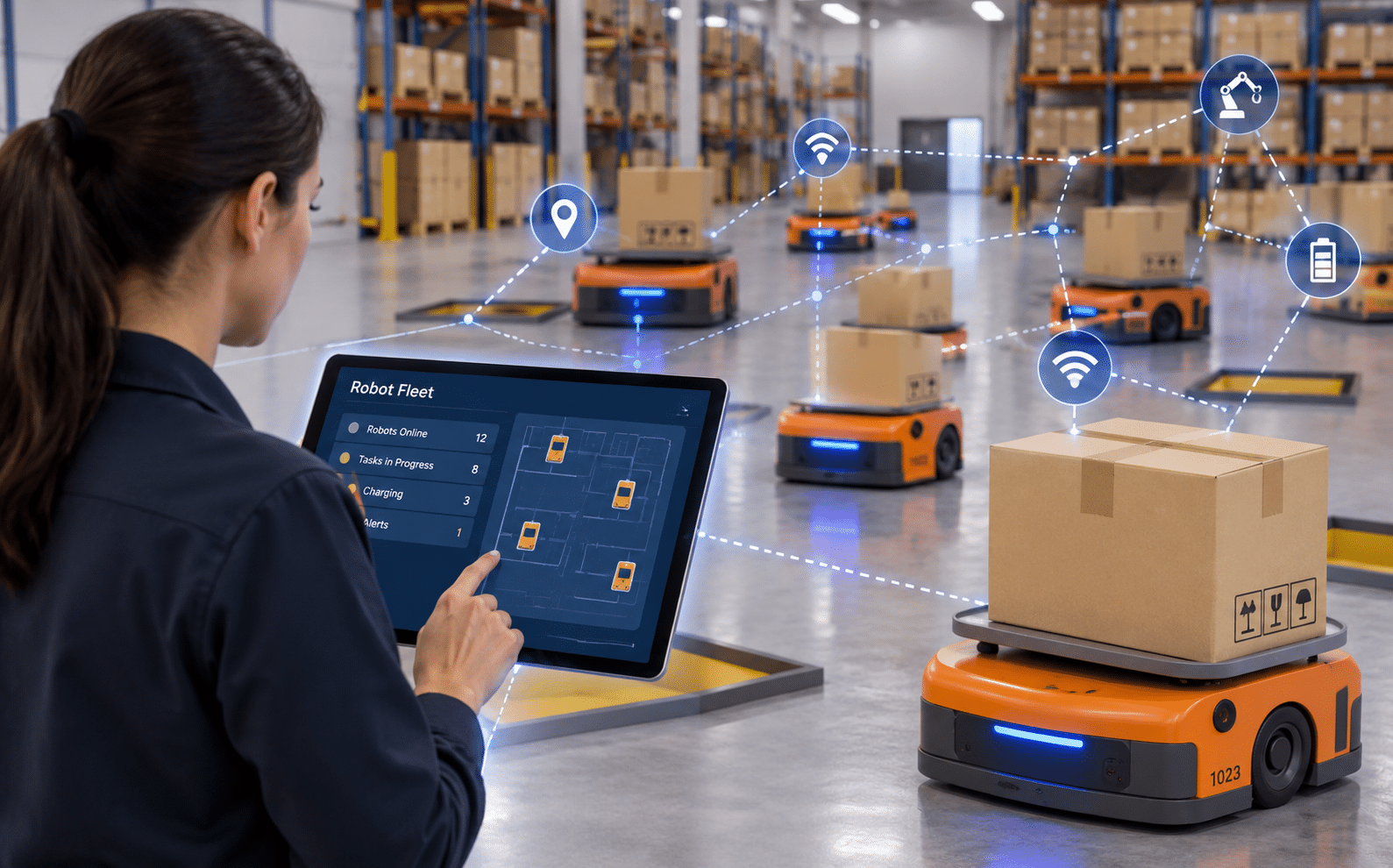
A robot operating in a kitchen, hotel, warehouse, factory, or home needs to understand more than how to move from one point to another. It may need to recognize objects, navigate around obstacles, manipulate items, respond to changing environments, and determine whether an action actually worked.
Collecting enough real-world training data for all those situations can be slow and labor-intensive.
Researchers at MIT’s Computer Science and Artificial Intelligence Laboratory (CSAIL) and Toyota Research Institute are exploring another approach: create virtual environments where robots can practice first.
Their system, called SceneSmith, uses AI agents to generate detailed 3D environments that can serve as training and testing grounds for robots.
What Is SceneSmith?
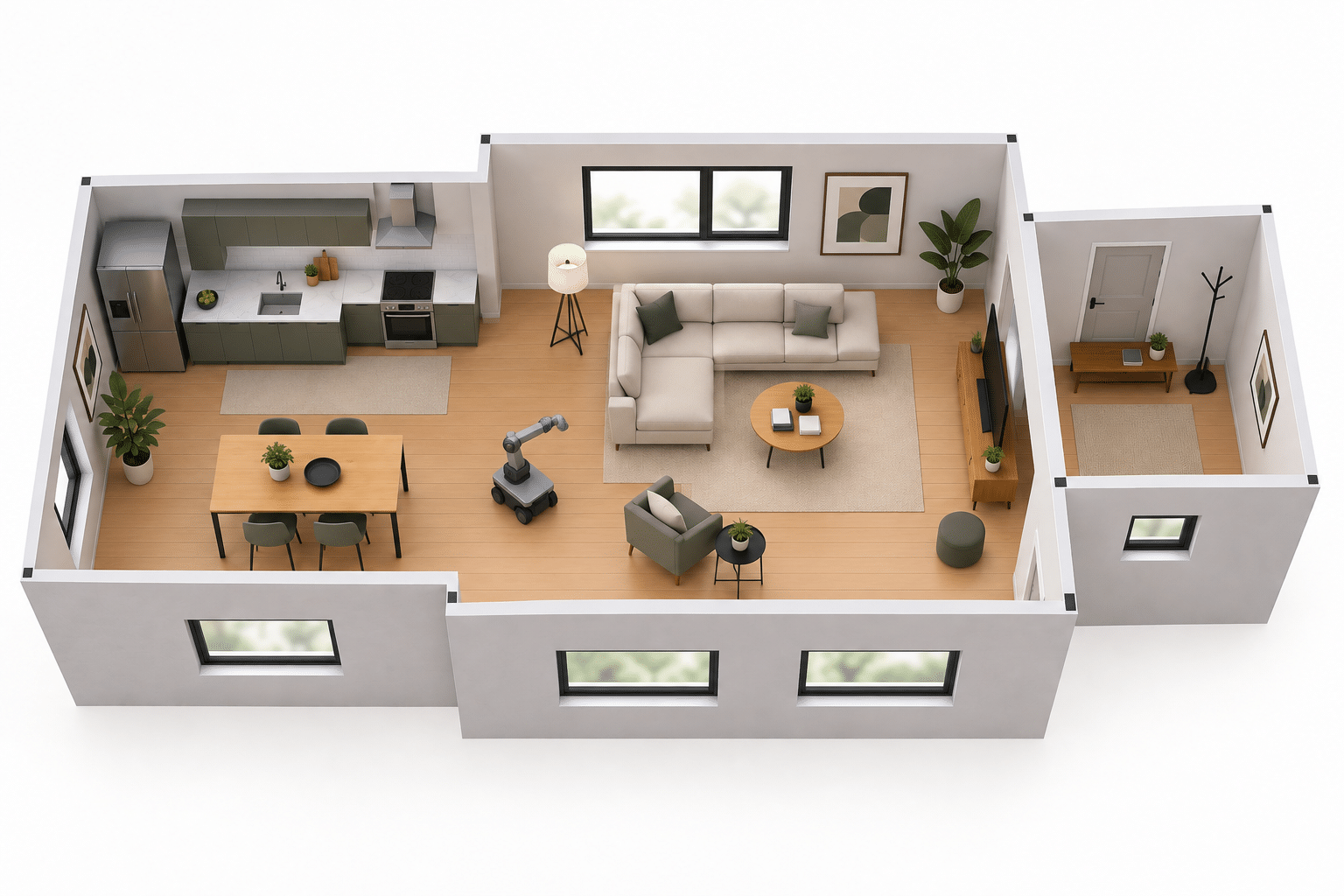
SceneSmith can generate simulation-ready indoor environments from a text prompt.
A user could ask the system to create a garage containing a car, stacked tires, workbench, and a ladder. SceneSmith then builds a 3D environment containing those elements and prepares it for use in robotics simulation.
The system uses three AI agents with different responsibilities.
A designer agent creates the environment. A critic agent evaluates whether the scene makes sense. An orchestrator agent manages the process and determines when the environment is ready.
Together, the agents build the scene in stages, from the basic floor plan to furniture, ceiling objects, wall objects, and items a robot can physically interact with.
The result is more than a 3D image.
Objects can have physical properties, and some elements, such as cabinets, can be opened and closed. That allows a simulated robot to interact with the environment rather than simply move through a visual representation of it.
Why Robots Need Virtual Training Environments
Physical robot training presents a basic problem: the real world contains an enormous number of possible situations.
Consider a robot being trained to work in a kitchen.
It may need to learn how to:
- Identify different objects
- Navigate around furniture
- Locate an item on a shelf or counter
- Pick up and move objects
- Place objects in specific locations
- Open cabinets
- Adjust when the environment changes
Testing every variation physically requires equipment, supervision, space, and time.
Simulation gives engineers another option.
A robot can attempt tasks repeatedly inside virtual environments before those behaviors are tested on physical hardware. Engineers can also expose the robot to different room layouts and object arrangements without rebuilding a physical testing space each time.
AI Agents Can Make Robot Simulation More Diverse
The challenge is that useful simulations need to reflect the complexity of real environments.
A nearly empty virtual room may be easier to create, but it does not necessarily give a robot enough variety to prepare for the physical world.
SceneSmith was designed to generate richer environments.
According to MIT, researchers created more than 1,300 scenes with the system. The generated spaces included environments such as bedrooms, offices, restaurants, hotels, stores, and gaming rooms.
The rooms could contain substantially more objects than environments produced by previous approaches.
That variety matters because robots need experience with more than one perfectly arranged environment.
A robot that performs well in one kitchen layout may encounter a very different arrangement somewhere else. Training across diverse simulations can expose robotic systems to more situations before physical deployment.
Robots Can Practice Everyday Tasks Before They Are Powered On
The virtual environments created by SceneSmith can be used to test robot behaviors and action plans.
Researchers evaluated robot policies across generated environments and tested tasks such as moving objects between locations.
In one example described by MIT, a robot was instructed to take an apple from a bowl and place it on a cutting board. A robot policy trained largely using real-world data was able to complete the task inside a SceneSmith-generated environment it had not previously encountered.
Researchers also teleoperated robots through the virtual environments to perform activities such as putting away bottles, opening cabinets, and moving between rooms.
These experiments demonstrate an important part of modern robotics: robot development increasingly happens across both physical and virtual environments.
Simulation Is Becoming Part of the Robotics Workflow
For students, robotics can sometimes appear to be mostly about building a machine and writing code that controls it.
Modern robotics involves a much larger system.
Engineers may need to create models, build simulations, generate training data, develop AI systems, test robot policies, analyze failures, and then validate those behaviors on physical hardware.
A workflow might look something like this:
Create a virtual environment → simulate the robot → test the robot’s behavior → identify problems → improve the system → test on physical hardware
The robot itself is only one part of that process.
AI, computer science, simulation, sensors, data, and engineering all come together to determine how the system behaves.
What This Means for Students Learning AI and Robotics
Research like SceneSmith gives students another example of how quickly the relationship between AI and robotics is developing.
Students entering these fields will need more than the ability to program a robot to move.
They may need to understand how AI systems make decisions, how data affects performance, how models are trained, how simulated environments differ from physical environments, and how engineers evaluate whether an autonomous system is ready for real-world use.
That creates opportunities for learning robotics in the classroom around questions such as:
How can a programmable robot learn without physically performing every possible task?
What happens when a robot encounters something that was missing from its training data?
How realistic does a simulation need to be?
How do engineers determine whether a behavior that works in simulation will also work in the real world?
These questions connect computer science and AI with robotics, data science, engineering, and autonomous systems.
Prepare Students to Work With AI Beyond the Screen
AI education does not have to stop at prompting a chatbot or generating content.
Students can learn how AI connects to programming, robotics, data, automation, and physical systems.
LocoRobo’s AI solutions help schools build hands-on AI learning experiences across grade levels, from introductory AI concepts and tools to Python, robotics, and more advanced applications of artificial intelligence.
Students can explore how AI systems work, evaluate their outputs, use AI alongside programming, and connect what they learn to real technologies being developed in robotics and automation.
Explore LocoRobo’s AI and K12 robotics solutions and bring hands-on artificial intelligence into your STEM and CTE program.