
Cybersecurity has always evolved alongside technology.
As organizations moved to the cloud, cybersecurity professionals learned to secure cloud environments. As connected devices became more common, security expanded into IoT. Now, AI is becoming part of that progression.
Artificial intelligence is giving cybersecurity professionals new ways to analyze information, automate routine tasks, identify patterns, and manage increasingly complex technology environments.
And that is beginning to change the skills students may need for cybersecurity careers.
AI Is Becoming Part of the Cybersecurity Toolkit
Cybersecurity teams deal with enormous amounts of information.
Networks generate logs. Security platforms generate alerts. Devices generate activity data. Organizations continuously monitor systems, users, applications, and infrastructure.
AI can help professionals make sense of that information more efficiently.
AI-enabled cybersecurity tools can assist with identifying unusual activity, analyzing security data, prioritizing alerts, and automating repetitive tasks. Instead of manually reviewing every piece of information, cybersecurity professionals can use these tools to help determine where their attention is needed.
The result is not less need for cybersecurity expertise. It is a change in how that expertise is applied.
Professionals may spend less time sorting through information and more time investigating, interpreting results, solving problems, and making decisions.
The Fundamentals Still Matter
AI may change the tools cybersecurity professionals use, but it does not eliminate the need for strong technical foundations.
Students still need to understand operating systems, networks, access controls, vulnerabilities, security policies, and incident response.
Before someone can use AI to help secure a network, they still need to understand how that network works.
That is why cybersecurity career pathways often begin with broader IT and networking knowledge. CompTIA’s pathway, for example, progresses through foundational IT and networking skills before deeper cybersecurity specialization.
AI becomes another layer built on top of those fundamentals.
Cybersecurity Professionals Are Learning to Work With AI
Knowing how to work effectively with AI is becoming another valuable cybersecurity skill.
A cybersecurity analyst might use AI-assisted tools to review security events. A security engineer might use AI-supported systems to identify patterns across large amounts of security data. A security operations team might use automation to prioritize alerts.
But professionals still need to understand what the technology is showing them.
Is the information relevant? Does the recommendation make sense? Does something require further investigation?
Using AI effectively requires the technical knowledge to evaluate its output rather than simply accept it.
This means students entering cybersecurity may need to develop two connected skill sets: understanding cybersecurity and understanding how AI can support cybersecurity work.
AI Can Make Cybersecurity Work More Efficient
One of AI’s biggest roles in cybersecurity is automation.
Security teams perform many tasks repeatedly. Systems need to be monitored. Alerts need to be reviewed. Information needs to be analyzed and documented. Vulnerabilities need to be prioritized.
AI and automation can help handle parts of that work more efficiently, giving professionals more time to focus on deeper investigation, planning, technical problem-solving, and decision-making.
This shift is already appearing in professional cybersecurity pathways. CompTIA’s SecAI+ certification includes skills related to using AI to strengthen security posture, automating security tasks, monitoring AI systems, and using AI-enabled tools in security workflows.
For students, automation itself is becoming something worth understanding.
AI Is Creating New Cybersecurity Skills
Organizations are using AI for cybersecurity while also adding AI applications and systems across their operations.
Those systems need cybersecurity expertise too.
AI applications rely on infrastructure, data, access controls, models, APIs, and other technologies that need to be managed and protected.
As a result, cybersecurity professionals can develop expertise in areas such as:
- AI security
- AI data security
- AI system monitoring
- Security automation
- AI governance and risk
- AI-assisted security operations
CompTIA has already introduced SecAI+ as an expansion certification for cybersecurity professionals seeking specialized skills related to AI and automation. It complements existing cybersecurity knowledge rather than replacing it.
That distinction matters.
AI is not replacing cybersecurity expertise. It is becoming another area where cybersecurity expertise can be applied.
What Should Students Learn?
For schools, AI does not mean rebuilding cybersecurity education around the newest AI tool.
It means giving students a strong enough technical foundation to understand and adapt to the tools they will encounter later.
That starts with:
- Computer hardware and operating systems
- Networking
- IT troubleshooting
- Access controls and authentication
- Security principles
- Vulnerability assessment
- Incident response
- Security monitoring
- Governance, risk, and compliance
As students progress, AI can become another part of that learning.
How can AI help analyze security information? Which cybersecurity tasks can be automated? How should professionals evaluate AI-generated recommendations? How are AI applications secured?
These questions connect cybersecurity fundamentals with the direction the industry is moving.
Hands-On Skills Still Matter
The growth of AI also reinforces the value of hands-on cybersecurity education.
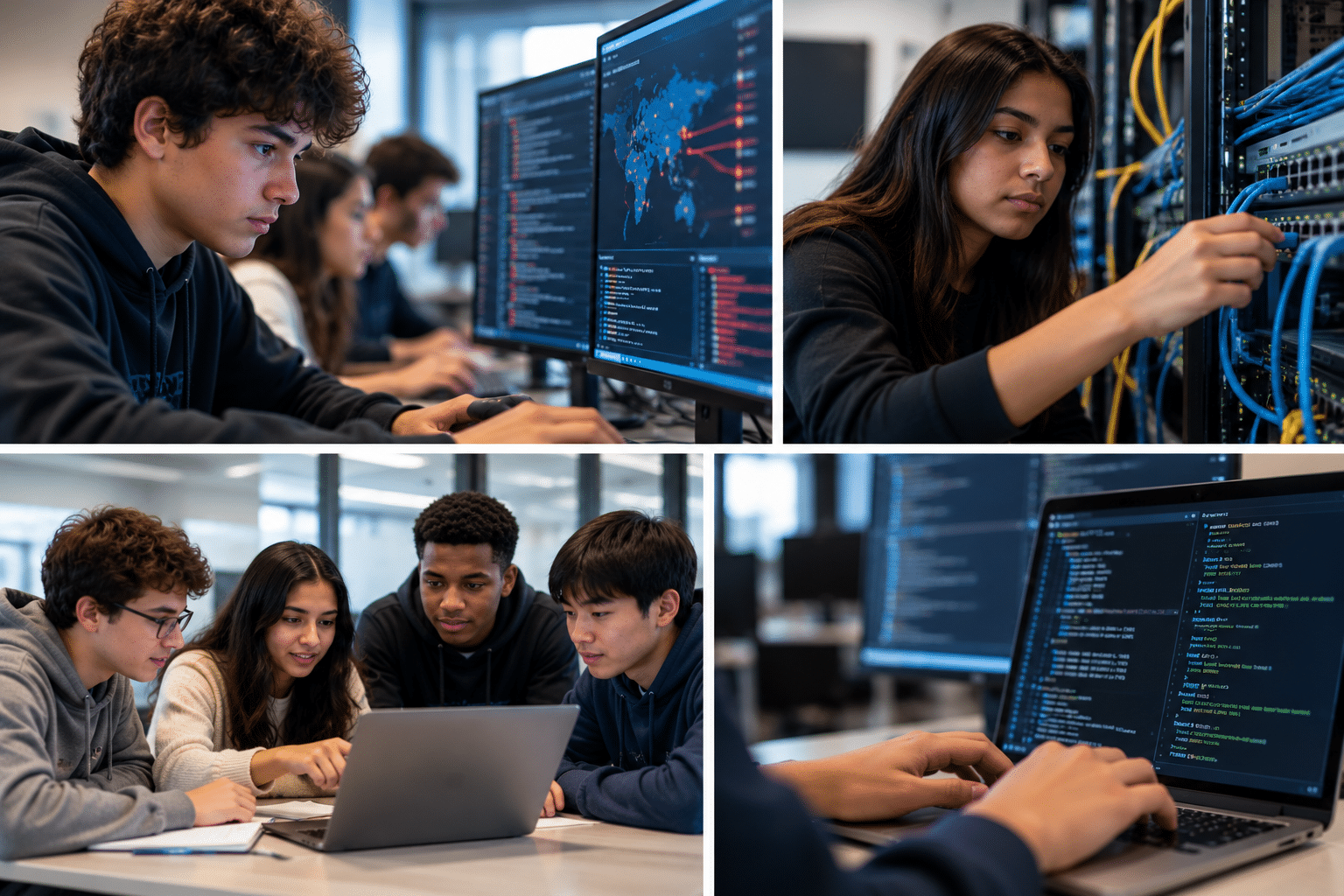
Students should have opportunities to configure systems, analyze problems, troubleshoot networks, identify vulnerabilities, and work through security scenarios.
Then, when they encounter AI-assisted tools, they have the knowledge needed to understand what those tools are doing. Students do not have to wait until their first cybersecurity job to start developing practical skills.
Preparing Students for Cybersecurity Careers in the Age of AI
AI is changing cybersecurity, but the foundation remains familiar.
Understand computers. Understand security. Understand networks. Learn how to identify and solve problems.
Then learn how AI and automation can make that work more efficient.
For students, that means building foundational IT and cybersecurity knowledge while developing the ability to work with emerging technologies.
For schools, the goal is not to teach every new cybersecurity tool that appears. Tools will continue to change. The goal is to give students the technical foundation and hands-on experience they need to keep learning as the industry changes.
Building the Foundation With LocoRobo
LocoRobo’s Cybersecurity pathway gives schools a structured way to build these skills progressively.
Students can begin with foundational computer systems and IT concepts, move into networking, and continue into cybersecurity through pathways aligned with industry-recognized certifications. Along the way, students develop the technical knowledge and hands-on experience that can prepare them to understand today’s cybersecurity tools while building a foundation for emerging areas such as AI-assisted security and automation.
As AI becomes a bigger part of cybersecurity, understanding the technology behind the tools will matter just as much as knowing how to use them.
Explore LocoRobo Cybersecurity Solutions.