
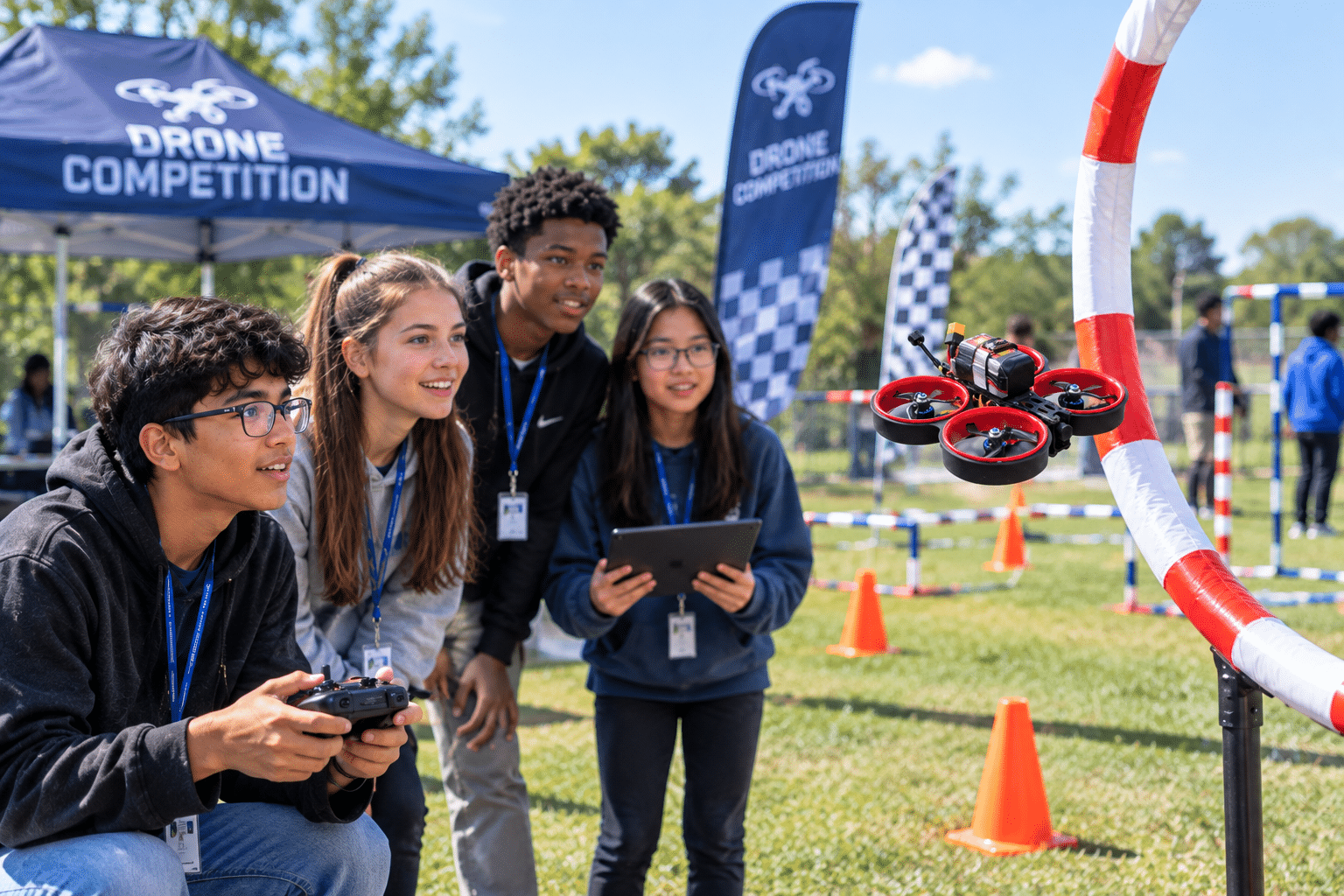
A drone competition may look like a race, a flight challenge, or a test of piloting skills.
But for students, the real learning happens long before the competition begins, and often continues long after the final flight.
When students prepare for a drone competition, they are learning how to solve problems, work with others, respond to failure, apply STEM concepts, and improve their performance through practice.
That makes drone competitions a powerful way to turn STEM learning into something students can see, test, and experience.
1. Problem-Solving Becomes Hands-On
In a traditional classroom, students might solve a problem on paper and move on to the next question.
With drones, the problem can be right in front of them.
A drone may miss a target, drift off course, fly too high, or fail to complete a planned maneuver. Students then have to figure out why.
Was the flight path wrong?
Was the code incorrect?
Did the pilot react too quickly?
Did the team misunderstand the challenge?
Instead of simply being told whether an answer is correct, students have an opportunity to investigate what happened and decide what to change.
The competition creates a reason to keep solving the problem.
2. Students Learn That Failure Is Part of the Process
One of the most valuable lessons competitions can teach is that getting something wrong is not necessarily the end of the process.
A failed flight provides information.
Students can review what happened, identify a possible cause, make an adjustment, and try again.
That cycle attempt, evaluate, adjust, repeat is at the heart of engineering and scientific thinking.
Competition gives students a tangible reason to keep improving. Instead of seeing failure as a final grade, they begin to see it as feedback.
3. Teamwork Becomes Essential
Drone competitions rarely depend on one student doing everything.
Teams may need students with different strengths: someone who understands the technology, someone who analyzes the challenge, someone who focuses on piloting, and someone who helps organize the team’s strategy.
Students have to communicate.
They have to divide responsibilities, listen to one another, make decisions under pressure, and figure out how their individual contributions fit into a larger goal.
These are skills that are difficult to teach through worksheets alone.
A competition creates a situation where collaboration has a real purpose.
4. Students Apply STEM Concepts to the Physical World
One of the biggest advantages of drones in education is that abstract concepts can become visible.
Physics concepts such as force, gravity, motion, thrust, and velocity can be connected to what students observe during flight.
Computer science concepts become tangible when students see how changing code can affect a drone’s behavior.
Math can become part of planning distances, measurements, angles, timing, and flight paths.
5. Coding Becomes More Than Writing Syntax
The rise of AI-generated code has changed the conversation around CS education.
Students can increasingly ask AI tools to generate code. But generating code is not the same as understanding it.
Drone challenges provide a useful way to make that distinction visible.
When students program a drone, they can immediately test what their code actually does. If the drone behaves differently from what they expected, they have to investigate.
Why did it stop there?
What happens if they change one part of the program?
Why did it turn too early?
This creates a valuable connection between code and consequence.
With TryDrones Division 3, students can use Python programming as part of semi-autonomous drone challenges. The physical result of their code gives them a reason to understand, test, debug, and improve it.
6. Students Develop Strategic Thinking
Competition introduces another layer that ordinary practice may not provide: strategy.
Students have to think beyond, “Can we do this?”
They begin asking:
What’s the best way to do this?
They may need to decide how to approach a challenge, how to divide responsibilities, where to spend practice time, or how to modify their strategy after an unsuccessful attempt.
That requires students to evaluate options, make decisions, and adapt when circumstances change.
7. Practice Has a Purpose
Students do not always see the value of repeated practice when there is no clear goal attached to it.
Competition changes that.
When students know they are working toward a specific challenge, practice becomes purposeful.
They have something to prepare for.
A competition challenge gives them a reason to refine their skills. A flight milestone gives them a target. Another team’s performance can give them a benchmark.
This can transform repetition from “doing the same thing again” into deliberate practice.
8. Students Learn to Communicate Under Pressure
Competition environments can reveal another important skill: communication.
Teams need to communicate quickly and clearly before and during challenges.
Students learn that saying, “Something went wrong,” is less useful than being able to explain what went wrong and what they think should happen next.
They learn to give and receive feedback.
They learn to explain their reasoning.
And they learn that good communication can directly affect team performance.
9. Competition Can Increase Student Ownership
Perhaps one of the most important outcomes is student ownership.
When students are given a challenge and the opportunity to improve their performance, they have more control over the learning process.
They experiment.
They make decisions.
They determine what needs more practice.
They ask for another attempt.
That shift can be powerful.
A student who says, “Can we try again?” is demonstrating more than enthusiasm. They are showing that they have identified a problem, believe they can improve, and want another opportunity to apply what they have learned.
That is meaningful engagement.
10. Students See a Connection Between Learning and the Future
Drone technology connects naturally to fields including engineering, aviation, robotics, computer science, data collection, automation, and other emerging technologies.
Competitions can help students see those connections in a practical way.
Instead of learning about technology only as a concept, students get experience using technology to solve problems.
For some students, that experience can be the first time they begin to imagine themselves pursuing a STEM career pathway.
Bringing Drone Competition Into the Classroom with TryDrones
For schools interested in introducing competition-based drone learning, TryDrones provides a structured pathway rather than treating competition as a standalone event.
Students can work through flight milestones and structured lessons that build toward competition challenges. This gives students a progression: they develop foundational skills, practice what they have learned, and then apply those skills in increasingly challenging situations.
TryDrones also provides different entry points for schools depending on students’ grade levels, experience, and program goals. Programs can range from foundational piloting and problem-solving to competition, Python coding, and more advanced drone applications.
Division 3 incorporates Python programming into semi-autonomous drone challenges, allowing students to see their code translated into physical action.
Most importantly, competition becomes part of the learning process—not simply something that happens at the end of a course.
Explore TryDrones and see how competition-based drone learning can fit into your school’s STEM or CTE program.