
The drone industry is not standing still.
What began largely with manual flight and aerial photography has expanded into a much broader field involving autonomous flight, mapping, inspections, surveying, data collection, public safety, agriculture, delivery, and AI-enabled systems.
And the industry is still growing.
The Federal Aviation Administration describes drones as one of the fastest-growing areas of U.S. aviation. Recent federal projections have placed the commercial drone fleet at more than one million aircraft, with continued growth expected as organizations adopt drones for more advanced operations.
As the technology changes, the skills behind it are changing too.
That creates an important question for schools:
Is drone education changing with the industry?
The Drone Industry Is Becoming More Advanced
Flying a drone is still an important skill. But increasingly, it is only one part of working with drone technology.
Modern drone applications can involve programming a drone flight path, collecting and interpreting data, operating sensors, creating maps, understanding airspace regulations, working with autonomous systems, and integrating drones with other technologies.
The FAA’s work around Beyond Visual Line of Sight operations illustrates where the industry is heading. Proposed regulations are designed to support more routine and scalable drone operations across applications such as agriculture, package delivery, aerial surveying, civic operations, training, and flight testing.
The FAA’s BEYOND program has already supported tens of thousands of advanced drone flights. Phase 1 included more than 70,000 flights, including over 48,000 beyond visual line of sight, and Phase 2 is continuing that work.
The drone is becoming part of a larger system involving software, sensors, automation, data, navigation, AI, and decision-making.
Drone Careers Are Expanding Beyond “Drone Pilot”
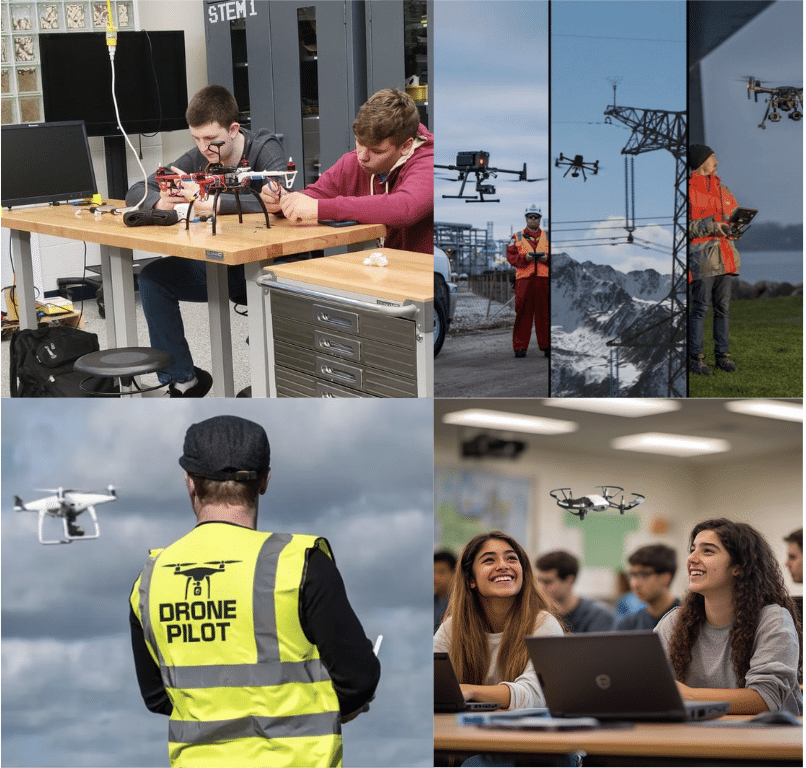
That shift matters for students because the drone workforce is becoming more diverse.
Someone working with drones might be involved in:
- Drone operations and flight
- Aerial mapping and surveying
- Agriculture and environmental monitoring
- Infrastructure inspection
- Public safety and emergency response
- Drone maintenance and repair
- Autonomous systems
- Software development
- Geospatial data
- Computer vision and AI
- Flight planning and operations management
Many of these careers do not fit neatly under the title “drone pilot.”
For example, surveying and mapping technicians increasingly work with drone-generated information. The U.S. Bureau of Labor Statistics projects employment for surveying and mapping technicians to grow 6% from 2025 to 2035, with about 6,900 openings per year on average. BLS specifically notes that drones are making parts of surveying more efficient while workers remain necessary to review and interpret the resulting data.
This is an important distinction for educators.
Preparing students with drones in education should not mean preparing every student to become a professional drone pilot.
It means helping students understand the range of technical skills that come together around drone technology.
Knowing How to Fly Is No Longer Enough
A student can learn the basic controls of a drone fairly quickly.
But what happens after that?
Can they program it?
Can they understand the data it collects?
Can they create an autonomous flight?
Can they troubleshoot a flight program?
Can they use coordinates and mapping?
Can they explain why an autonomous system made a particular decision?
Do they understand the regulations governing commercial drone operations?
Those questions move drone education from simply learning to operate a device toward learning the systems behind it.
That is where coding, mathematics, physics, engineering, data science, AI, and aviation begin to intersect.
A drone can become a platform for teaching much more than flight.
Schools Need to Teach Transferable Drone Skills
There is another challenge for educators: the drone for schools that students use today may not resemble the systems they encounter several years from now.
Hardware changes.
Automation improves.
Software changes.
Regulations change.
New applications appear.
That means schools cannot build drone programs around one specific device or one narrow technical task.
Students need foundational skills they can carry from one system to another.
Drone programming is one example. A student who understands variables, functions, loops, coordinates, sensor input, and autonomous navigation is developing concepts that extend well beyond a particular drone.
The same is true for troubleshooting, data interpretation, engineering design, computational thinking, and understanding how hardware and software interact.
The goal is to give students enough technical foundation to keep learning as the industry changes.
Drone Programs Should Be Designed to Grow With Students
A strong K-12 drone pathway should not introduce every advanced concept at once.
Students can build toward them.
Elementary students might begin by exploring flight, spatial reasoning, sequencing, and block-based programming.
Middle school students can progress into more structured coding, flight challenges, data collection, and autonomous missions.
High school students can work with Python, autonomous navigation, mapping, AI concepts, advanced flight systems, and FAA Part 107 preparation.
The drone technology becomes more sophisticated as students’ skills grow.
That creates a pathway instead of a one-time drone activity.
Keeping Drone Education Relevant With LocoRobo
At LocoRobo, our drone education solutions are designed around that progression.
Students can begin with accessible hands-on drone learning experiences and continue into coding, autonomous flight, mapping, AI, and career-connected aviation concepts.
LocoDrone provides grade-band pathways from elementary through high school, including block-based programming, Python, mapping, autonomous systems, and advanced drone applications.
CodeMyDrones helps schools teach drone programming through blocks and Python while supporting multiple drone platforms, giving students from elementary through high school experience with computer science concepts through physical flight.
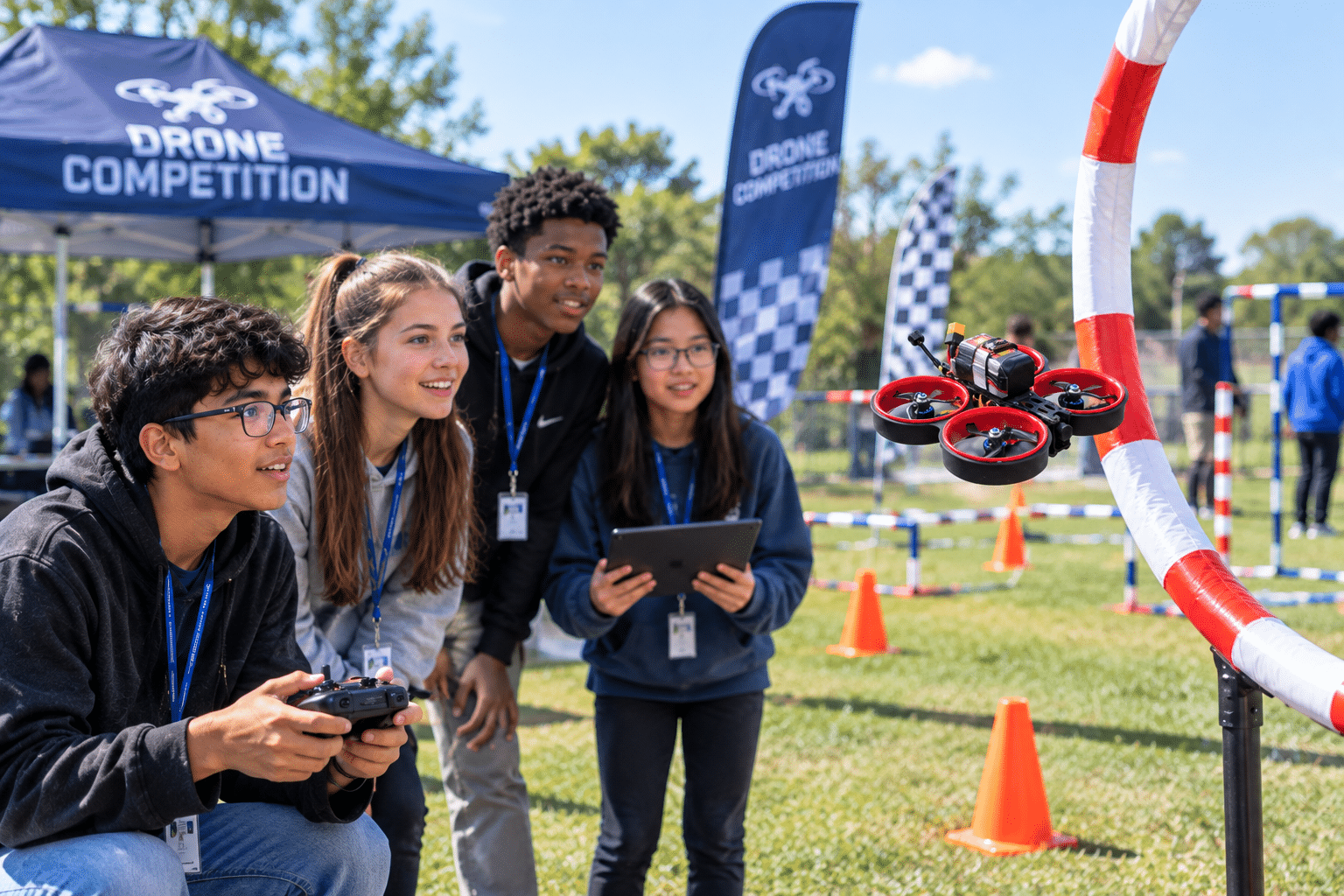
TryDrones introduces students to drone competition, coding, flight skills, and progressively more advanced applications.
For high school students interested in professional drone operations, LocoFly provides 50+ lessons supporting preparation for the FAA Part 107 Remote Pilot certification.
Our goal is to help schools build drone programs that can progress with students and stay connected to where the industry is going.
Because the drone industry students may enter several years from now will continue to change.
Their education should prepare them to change with it.