
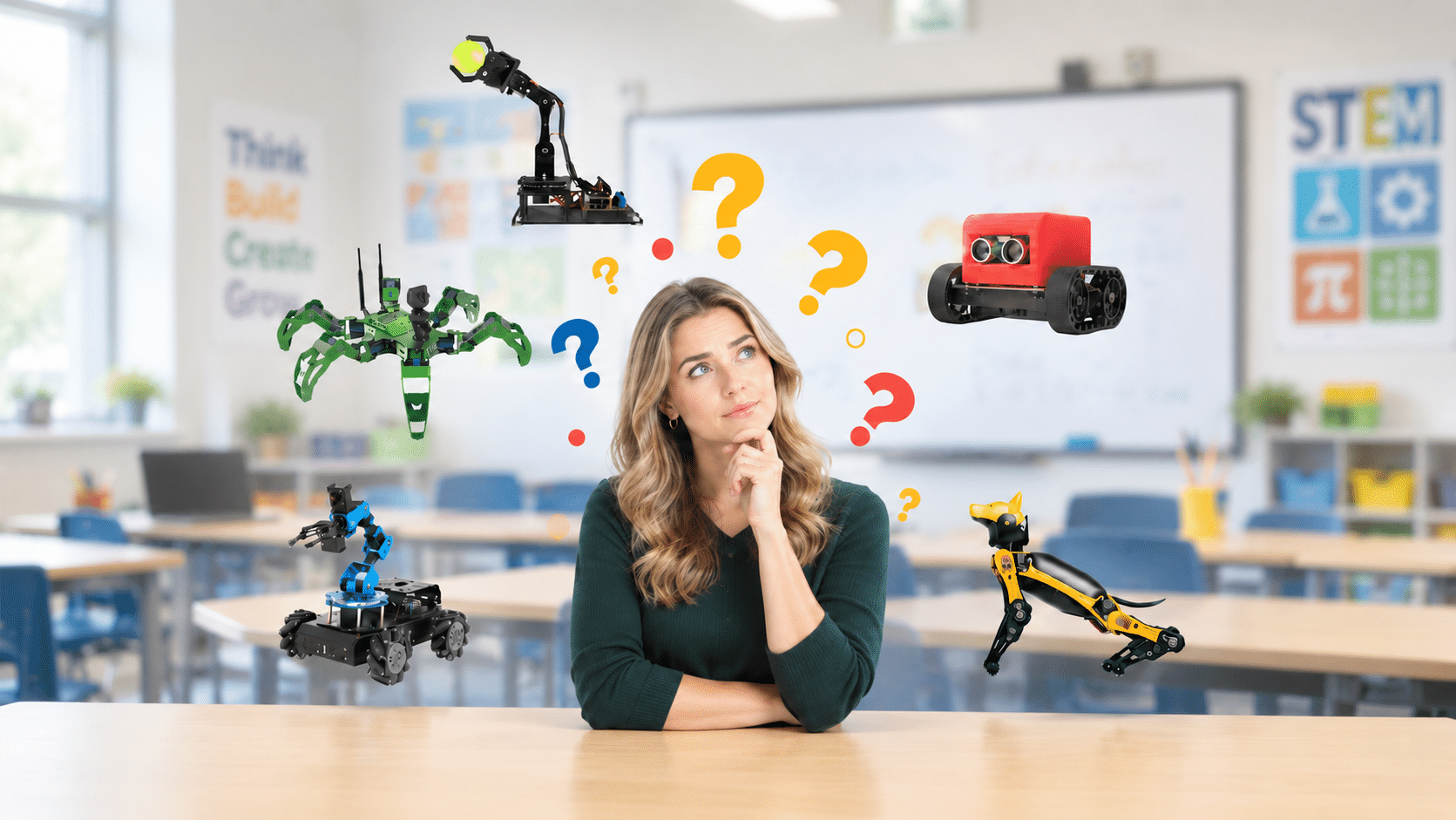
There is no single “best” classroom robot.
A robot that works well for introducing coding to elementary students may not provide enough depth for a high school engineering course. A robotic arm designed for automation projects serves a very different purpose from a quadruped robot used to explore sensors, movement, and autonomous navigation.
That is why schools choosing robots for STEM learning should start with a different question:
What do we want students to learn with the robot?
The best classroom k12 robotics programs give students room to progress from foundational coding and problem-solving to engineering, automation, AI, and autonomous systems.
Here is what schools should look for when choosing STEM robots and which types of robots work best for different learning goals.
What Makes a Good Robot for STEM Education?
Robotics in the classroom should do more than move when a student presses a button.
The strongest educational robotics platforms give students something to program, investigate, test, troubleshoot, and improve.
When evaluating robots for STEM learning, schools should consider:
- Age and grade level: Look for a robot that matches what students are ready to learn, from basic movement and coding to more advanced robotics, AI, and automation.
- Programming options: Consider where students will start and where you want them to progress. Support for block coding, Python, Java, or multiple languages can help students build their programming skills over time.
- Robotics curriculum: The robot should come with lessons, projects, and challenges that give teachers a clear way to use it for instruction, not just instructions for operating the hardware.
- Sensors and hardware: Students should be able to work with components such as cameras, motors, sensors, and LiDAR so they can see how code controls and responds to physical systems.
- Room for progression: A good STEM robot should support more than introductory activities. Students should be able to move from basic challenges to increasingly complex programming, engineering, and autonomous robotics projects.
- Real-world connections: Look for robots that let students work on problems similar to those found in fields such as logistics, manufacturing, autonomous systems, engineering, and AI.
- Teacher support: Consider what teachers receive beyond the robot, including training, implementation guidance, technical support, and ready-to-use resources that make robotics practical to teach.
Best Mobile Robots for Coding and Autonomous Navigation
Mobile ground robots are one of the most versatile starting points for classroom robotics.
Students can begin with relatively straightforward tasks such as programming a robot to move a specific distance, turn at an angle, or react to an obstacle.
Those same activities can later become much more complex.
Students might use sensors to navigate an environment, optimize a route, respond to changing conditions, or create an autonomous system that makes decisions based on incoming data.
This makes mobile robots useful for teaching:
- Coding
- Sensors
- Computational thinking
- Engineering design
- Autonomous navigation
- Troubleshooting
- Algorithm development
- Automation
LocoXtreme: From Coding to Autonomous Robotics
LocoXtreme is LocoRobo’s four-wheel autonomous ground robot designed for K-12 STEM learning.
Students can program LocoXtreme using block-based coding and Python, allowing schools to use the same robotics platform across different levels of programming experience.
Beginners can focus on movement, sequencing, and basic sensor behavior. More experienced students can investigate autonomous navigation and problems connected to technologies used in AI, transportation, and logistics.
That progression is important when schools want robotics to become part of a larger STEM or computer science pathway rather than a one-semester activity.
Best Quadruped Robots for Exploring Movement and AI
Quadruped robots introduce students to a completely different engineering problem: How do you make a machine move effectively on four legs?
Instead of simply controlling speed and direction, students can investigate gait, balance, movement patterns, sensors, pathfinding, and autonomous behavior.
Quadruped robotics can support lessons involving:
- Coding
- Sensors
- Mechanical movement
- AI
- Pathfinding
- Autonomous systems
- Engineering design
It also gives teachers opportunities to connect classroom projects to applications such as environmental monitoring, inspection, and search-and-rescue robotics.
LocoScout: Quadruped Robotics for Grades 3-12
LocoScout brings quadruped robotics into STEM classrooms across grades 3-12.
Students can use block-based coding and Python to program movement and complete challenges involving automated pathfinding and simulated real-world missions. The platform can also be expanded with AI modules, sensors, and automation features as students move into more advanced work.
For younger students, the appeal of programming a quadruped robot can provide an accessible entry into robotics. Older students can move beyond basic movement and investigate the engineering and programming behind autonomous robotic systems.
Best Robotic Arms for Automation and Manufacturing
If students are learning about engineering, automation, or manufacturing, a robotic arm provides a very different experience from a mobile robot.
Industrial robotic arms perform highly controlled tasks repeatedly. They can move components, sort products, handle materials, assist with assembly, and perform other processes where precision matters.
In the classroom, students can explore the same underlying ideas through challenges such as:
- Picking up and placing objects
- Sorting items
- Coordinating multiple actions
- Programming repeatable movements
- Improving the efficiency of a process
- Designing automated workflows
Instead of programming a robot simply to “do something,” students have to think about the entire process.
Where should the object move? How should the arm approach it? What sequence of movements is most efficient? What happens when the object is in a different position?
These are valuable engineering problems.
LocoArm: Hands-On Automation for Grades 6-12
LocoArm is designed to introduce students in grades 6-12 to robotic automation.
Students can use Python-controlled motion and logic to create pick-and-place systems, automated sorting activities, and robotic assembly projects. The system can be adapted for stationary or mobile applications, giving students opportunities to explore automation scenarios connected to logistics, healthcare, and manufacturing.
For schools building engineering, robotics, manufacturing, or CTE programs, robotic arms can help connect programming lessons to the physical systems students may encounter beyond the classroom.
Best Advanced Robots for Mapping and Exploration
Once students understand foundational robotics and programming, the next challenge is getting a robot to understand and navigate a more complex environment.
Advanced robotics introduces questions such as:
Where am I?
What is around me?
Where should I move next?
How should I respond when the environment changes?
These questions introduce students to technologies such as LiDAR, depth cameras, mapping, autonomous navigation, and AI.
LocoHex: Advanced Robotics for Grades 10-12
LocoHex is a hexapod robotics platform designed for grades 10-12.
Students can work with technologies including LiDAR, Python programming, depth cameras, terrain-adaptive movement, autonomous navigation, and AI-based mapping. Projects can explore applications such as terrain analysis, precision mapping, agriculture, exploration, and search-and-rescue robotics.
Because students can also integrate additional sensors, AI, and automation capabilities, LocoHex provides room for experimentation beyond predefined activities.
This type of platform is better suited to students who are ready to investigate robotics as a complete system rather than simply learn introductory coding.
Best Robots for Combining Mobility, Robotic Arms, and AI Vision
Many real robotic systems do not perform just one function.
A warehouse robot might navigate to a location, identify an object, manipulate it, and transport it somewhere else. An autonomous system therefore has to combine sensing, mobility, decision-making, and manipulation.
For advanced STEM and CTE students, bringing several of these capabilities together creates much richer engineering problems.
LocoRover: Mobile Robotics, Automation, and AI
LocoRover combines an omnidirectional mobile platform with a programmable robotic arm and AI vision capabilities.
Its Mecanum-wheel drive allows 360-degree movement, while the robotic arm supports pick-and-place tasks and coordinated automation. Students can also explore computer vision, object tracking, and autonomous decision-making.
Instead of studying navigation, robotic manipulation, and AI as completely separate concepts, students can investigate how they work together within a robotic system.
That makes this type of platform particularly useful for advanced robotics, engineering, AI, automation, and CTE programs.
Which STEM Robot Is Best for Your Classroom?
The best STEM robot depends on what you want students to learn. LocoXtreme supports coding and autonomous navigation, LocoScout introduces quadruped movement, sensors, and pathfinding, LocoArm focuses on robotic automation and manufacturing concepts, LocoHex brings advanced navigation and mapping into high school robotics, and LocoRover combines mobility, robotic manipulation, and AI vision.
LocoRobo helps schools choose the right robotics experiences for their students and build a pathway supported by k12 robotics curriculum, programming tools, projects, and teacher support. Explore LocoRobo Robotics Solutions to find the right fit for your STEM or CTE program.